Home
What's New?
Photography News
Essentials New Camera?
Technique
Composition
Lighting
Exposure
Focus
Improving Tutorials
Masterclasses
Workflow
Critiques
Top Tips
Your Questions
Some Answers
Product Reviews
DSLR Video Video Shooting
Video Editing
Video Sound
Editing Fixes & Effects
Horizons
Verticals
Red Eye
Too Dark
Distractions
Monochrome
Depth of Field
Cropping +
Extraction
Effects
Sizing
Framing
Inspiration Photo Ideas
Free Images
Galleries
Slideshows
The RPS
Good Books General Technique
Landscape & Travel
Wedding & Portrait
Wildlife & Nature
Underwater
Background About the Editor
About this Site
Privacy Policy
Contact Me
Site Map

[?] Subscribe To This Site

XML RSS
Add to Google
Add to My Yahoo!
Add to My MSN
Subscribe with Bloglines

Colour Temperature

"Camera Blindness"

"Colour Temperature?" - What has temperature got to do with colour?

Have you ever noticed how much redder things look outside in the early morning or late evening when compared with mid-day?
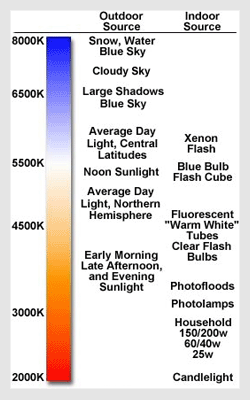
Colour Temperature


On a cloudy day, some colours appear more blue than when the sun is shining.


The sun is consistently the light source and yet, depending on the time of day and the amount of water in the atmosphere, it’s effect on the colour of things changes - like a rainbow.


Indoor lighting also has it’s effect. Fluorescent lighting casts a greenish colour, tungsten bulbs make things appear more orange and candle light turns colours redder still.


At the red end of the spectrum colour temperature is low, at the blue end it is high. It’s curious how we think of red as a warm colour and blue as a cool one - the exact opposite of the way it is measured.

Feel free to skip over this next bit unless you are keen to know why.

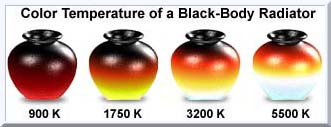
The colour temperature model is based on the relationship between the temperature of a theoretical standardized material, called a black body radiator, and the energy distribution of its emitted light as the radiator is brought to increasingly higher temperatures, measured in Kelvin (K).

Although this radiator does not exist, many metals behave very similarly to a black body so we can take a metal pot as an example.

Colour Temperature


In this illustration the metal pot is first heated to a temperature of about 900 K (pot on the left), where it begins to glow a dull red. As the temperature is increased to between 1500 and 2000 K, the pot (second to the left) turns a yellowish to brighter red colour.

As the temperature is further increased above 3000 K the colour turns to a yellow-white (the third pot from the left), and at 5000 K and above (the pot on the far right), a bluish-white color appears.

(Explanation and Illustration courtesy of Olympus Corporation)


All light affects the way we see colours but we compensate and mentally adjust the colours back to what we are used to. We see a Caucasian's skin as flesh pink, no matter what colour the light source changes it to, but when it comes to photography lighting -

A camera does not have the capability to automatically compensate for colours.

It has to be told the colour of the light source if it is to record colours accurately. Modern cameras have clever means of estimating the colour of the light but all cameras can be fooled so it’s worth knowing how to set it correctly.

Unless your camera is completely automatic and you cannot change its settings, your instruction book will tell you how to adjust for the colour of the light source.

Colour Temperature


New! Comments

Have your say about what you just read! Leave me a comment in the box below.

Better Photographs


Photography Techniques


Find It

Custom Search


This Month's Free Image
Free Downloadable Photographs
Click here to download it.


Book of the Month
A Guide to Astrophotography
Click here to read the review.